听力实验室 TingliLab.com · Mandarin for tingli (听力) ears Open the lab

听力实验室 TingliLab.com · Mandarin for tingli (听力) ears

A Mandarin lab for adult learners and teachers: listening clips written from your own word list, a conversation partner, tone and dictation drills, handwriting, and your own texts.

Free accounts with daily limits are open now (100 places to start, 18 or over).

No account needed to look around: Try it on the sign-in screen.

A listening clip in TingliLab: a dialogue about weekend plans, with pinyin under each word and the English translation

What's in the lab

The practice tabs, named in Chinese first, as they are in the lab.

听 Listen

New clip writes a short dialogue or story around ten words from your bank, at the length and difficulty you set, and reads it aloud in a natural voice. Listen first; then reveal the characters, the readings (pinyin, zhuyin or both) and the English in steps, tap any word to replay from it, or hear the whole clip again more slowly.

Words you don't know yet are marked, logged as new, and ready to copy into your flashcard app. Prepare 5 makes clips in advance, to play later or offline.
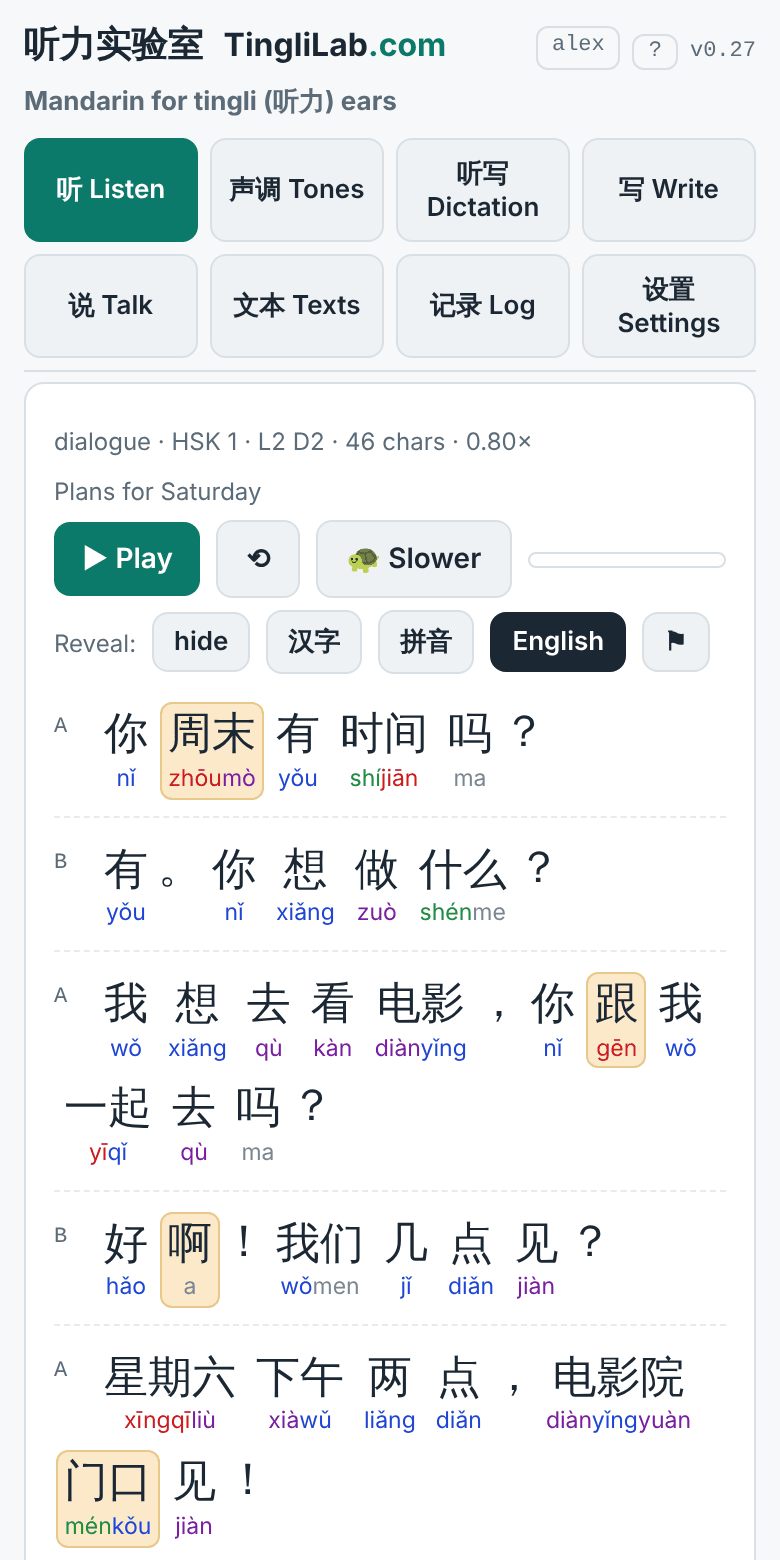
The same clip on a phone: the dialogue with pinyin under each word, and the English below

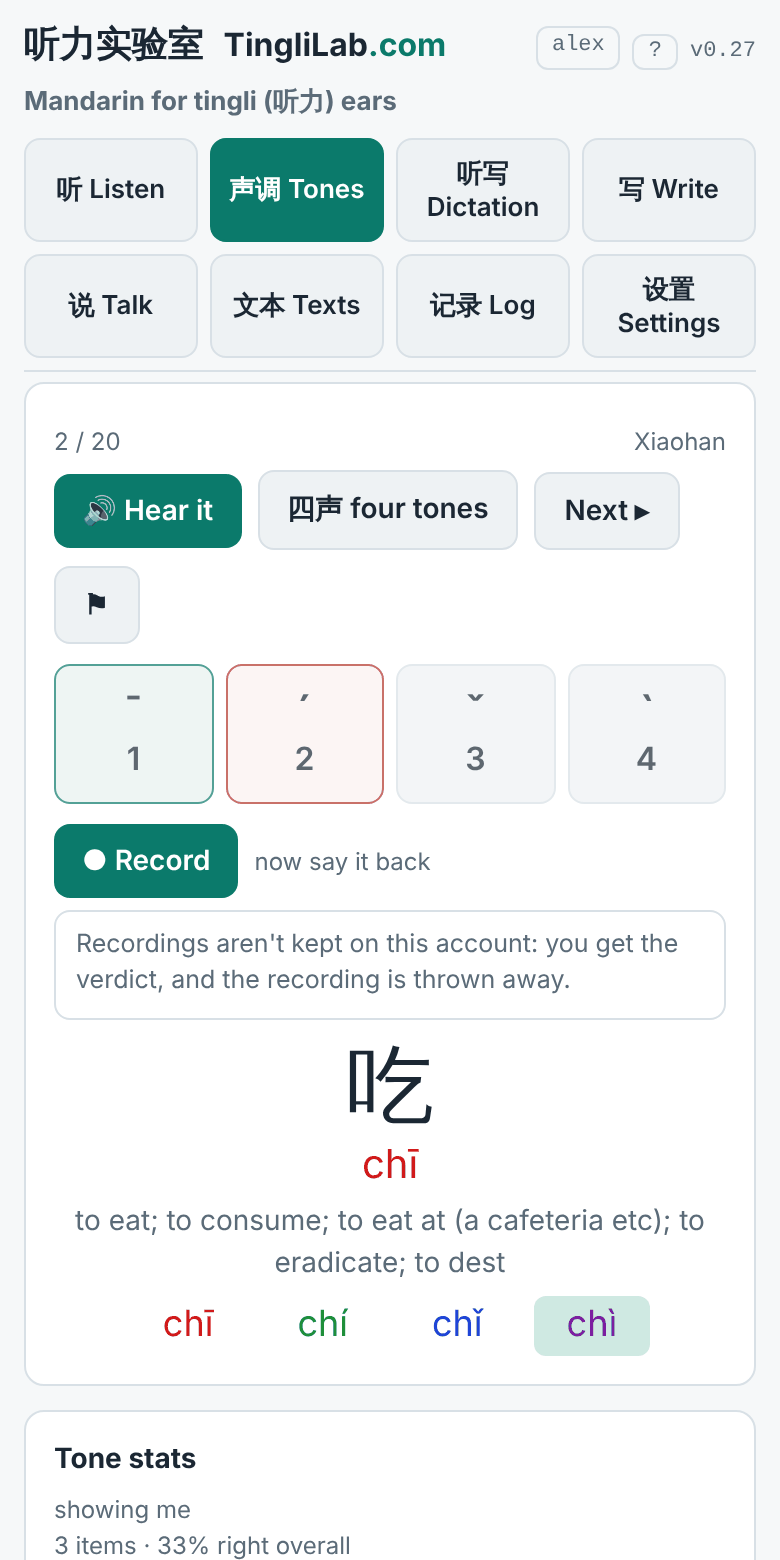
声调 Tones

Hear a syllable or a two-syllable word and tap its tones; play any syllable in each of its four tones in the same voice; take the pair quiz, with the tone changes real speech makes.

In repeat-back you say it back, and the lab draws your pitch over the voice's, with a verdict for single syllables. Every syllable it drills is a stored clip in four voices, so tone practice costs nothing and works offline once a voice is prepared.

Tone practice on a phone: the right tone shown after a wrong answer, with the syllable in all four tones

听写 Dictation

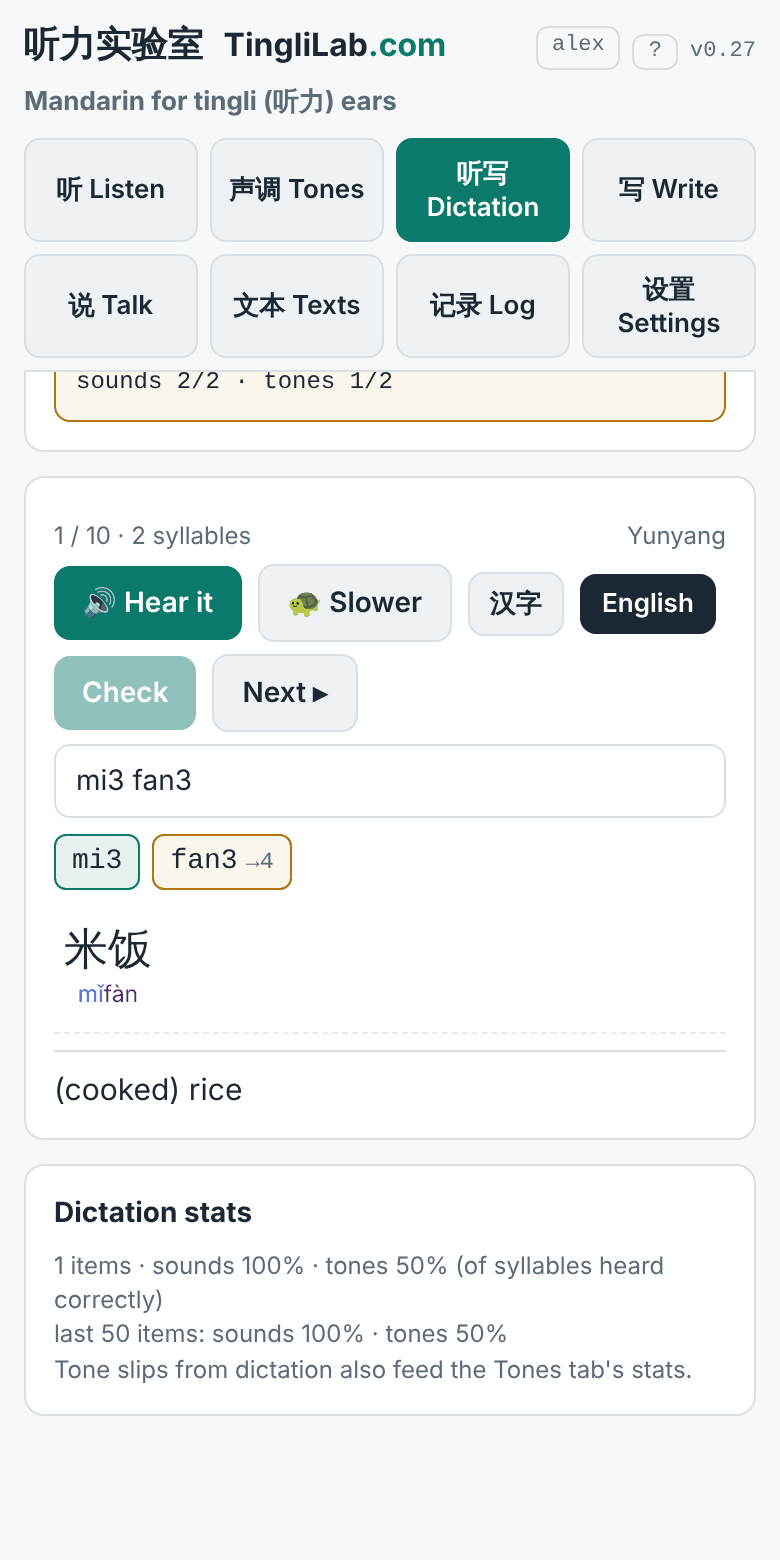
A line from one of your clips, or a word from your bank, plays; you type what you hear in pinyin or in 注音 zhuyin, and each syllable is marked for sound and tone.

On the HSK 1–3 words it plays stored clips, with Mainland or Taiwan readings, and it doesn't count against a free account's daily limits.

Dictation on a phone: the typed pinyin marked syllable by syllable, with the right tone shown

写 Write

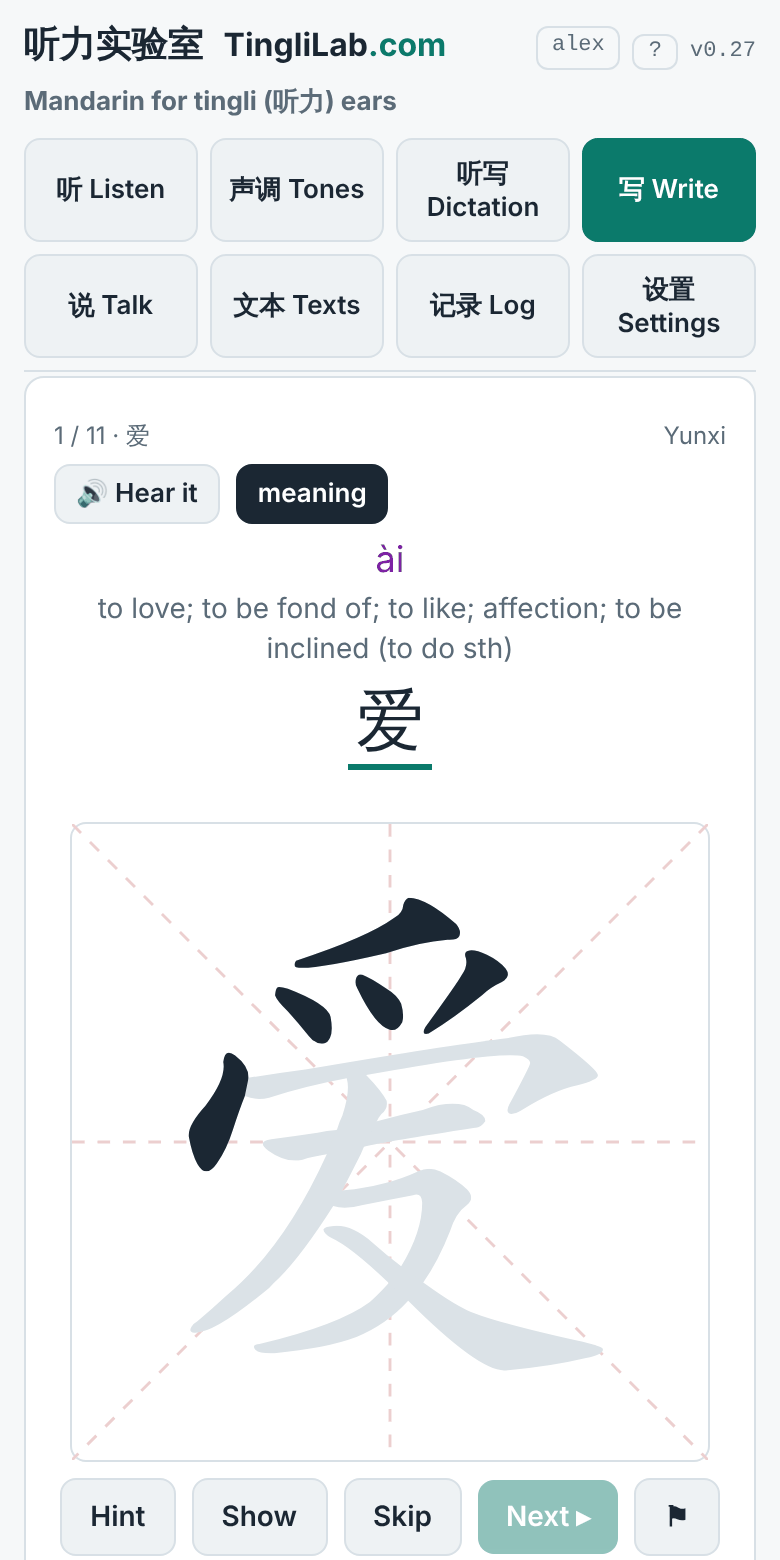
Learn to write the characters you've been hearing: watch the strokes, trace them, then write the character from memory, prompted by its sound, its pinyin or its meaning.

Every stroke is checked as you draw it, on your device, for shape, direction and order. What needed help comes back the next day, until you write it cleanly from memory.

Handwriting practice on a phone: tracing the strokes of a character on a grid

说 Talk

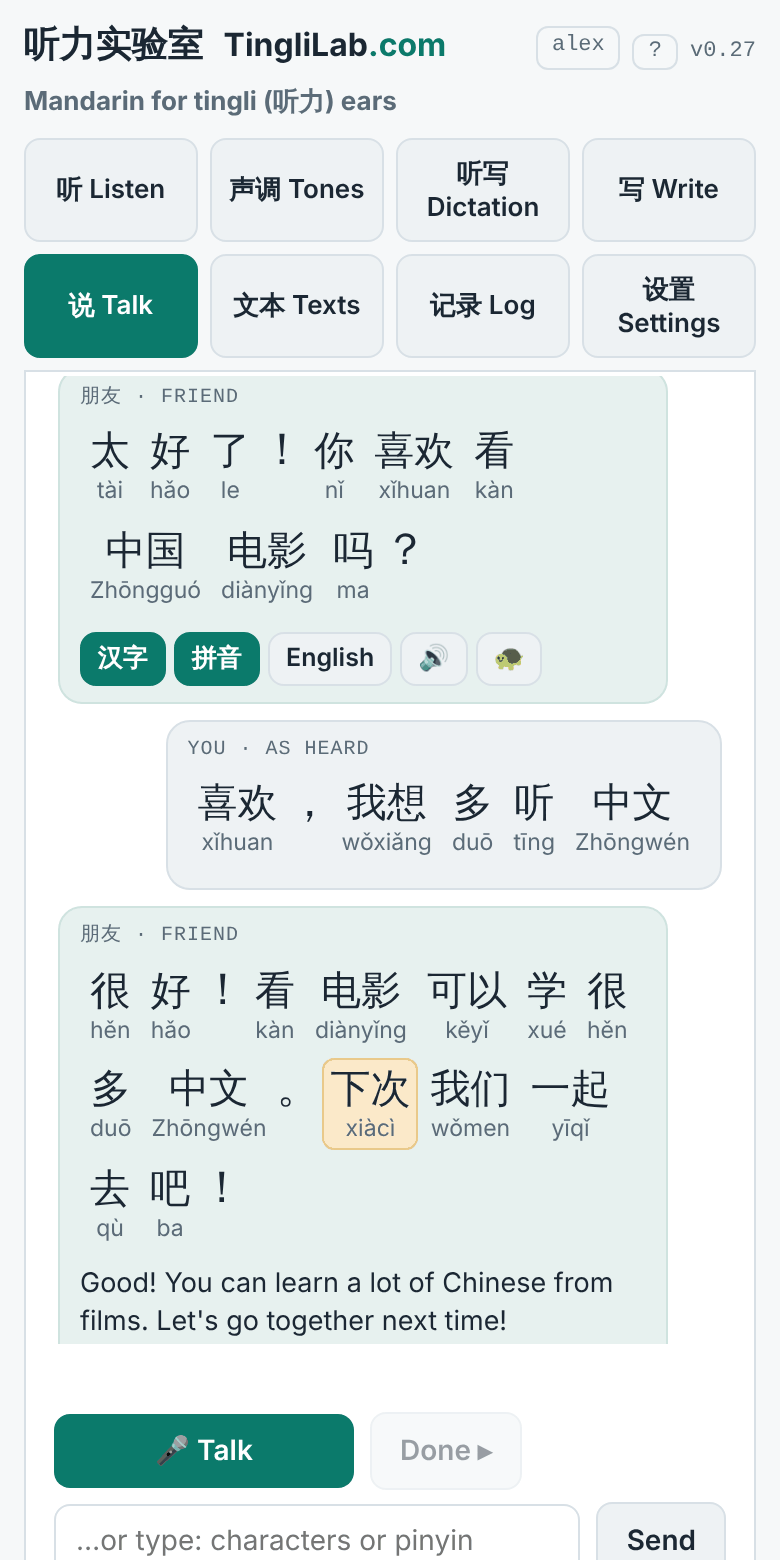
A spoken conversation with an AI partner playing a role (a friend, a shop assistant, a taxi driver, a stranger on the bus) on an everyday topic, at your level: HSK 1, HSK 1–2, HSK 1–3 or no limit.

Replies come listen-first; tap to talk, or go hands-free. The partner never corrects you mid-conversation, and a debrief afterwards gives you the words you were looking for and two of your lines said even better.

A conversation on a phone: Chinese with an AI partner, with pinyin and an English translation

文本 Texts

Paste any Chinese text (a reader page, a song, a chapter) and it becomes passages with readings, a translation and questions, read aloud by your voices and played like any clip.

记录 Log

What you've heard and practised, with every round's score and replayable clips, and the words you've met: copy the new ones out, one per line, for a flashcard or writing app.

  • An account syncs your words, clips and results across your devices.
  • Installs to a phone from the browser's menu, and works offline for what's been prepared.
  • Mainland or Taiwan readings: pinyin, zhuyin or both, and Putonghua or Guoyu.

Who it's for

Self-taught adults, beginner to lower intermediate

The drills cover the HSK 1–3 words; Listen and Talk work from your own word list at the level you set. It is not a course and not a flashcard app: use it alongside whatever you use for characters and vocabulary.

Teachers and tutors

Classes with codes, students' logins on printable cards, and each student's progress, with under-18s only through a teacher and a parent's consent. Classes and students.

How it started

Built by Ranjan in Canberra for my own learning, which began in September 2026. It began with listening, and with tones, where a self-taught learner gets little honest feedback; a few native-speaker friends tested it, and it is still one person's project. About.

The free tone lab

TingliLab.org is the free tone lab: tone dictation, four tones, repeat-back with a tone judge, HSK 1–3 dictation and handwriting, with no account and no limits.